Problem
Second Summer is a one-person Landscaping Architecture Firm that has been branching out into other forms of service related to landscaping. The client has articles, blogs and even an online course for the elderly to learn more about landscaping and DIY gardening. This previous course took a lot of time and effort to make but the students did not engage with the client or each other as much as she liked. So, when she came up with an idea for a course targeting a different audience, she decided to do research first. Our client reached out to my friend for help who then turned to me to help conduct research.Our ultimate goal was to figure out:
Second Summer

What is this potential user base looking for in an online landscaping course?
Research
Interview
Some of the Questions from the Interviews
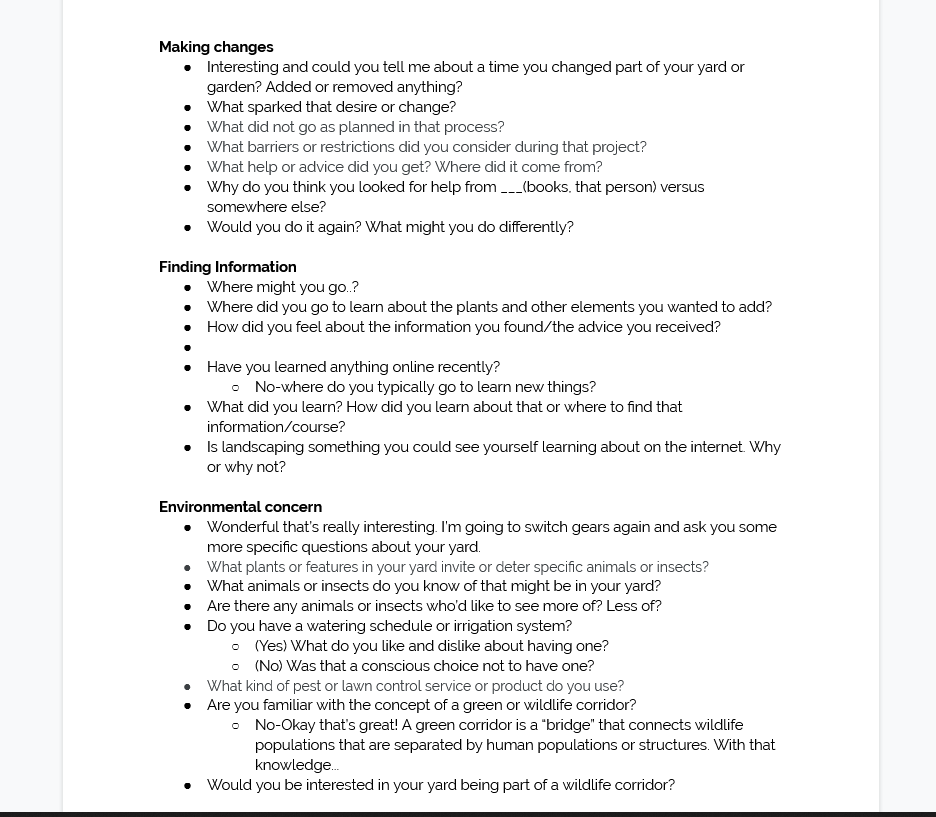
Before I was brought in, my partner had created a screener and recruited six participants to be interviewed. We had questions specific to landscaping like how they used their gardens or yards and how much time they spend landscaping or gardening. We also had broader questions on how they learned to make sure that the class was in a medium that they would use. Our participants were:
- Home Owners
- From different parts of Austin, TX
- Different Socio-Economic Status
- Concerned over price
- Maintained their own yards and gardens
Analyze
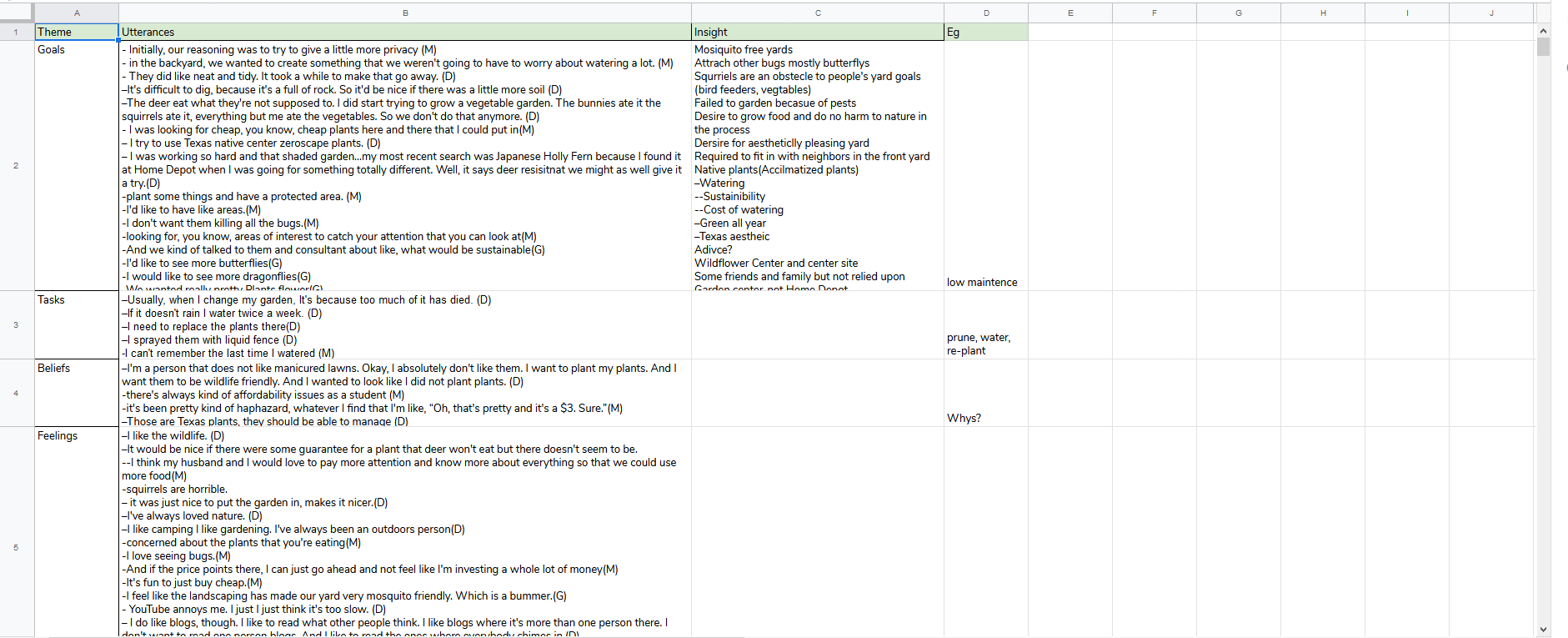
To gain meaningful insights, we decided to code the interviews so that we could group and compare our participants answers and find patterns among them. We grouped what they said into 5 categories:
- Goals - What users wanted to do
- Tasks - What users had to do
- Beliefs - What users thought
- Feelings - How our users felt
- Facts - What our users knew
We then went through the groups together and discussed what we found.
Part of the Spreadsheet of Interview Coding
Empathy Map on Whiteboard
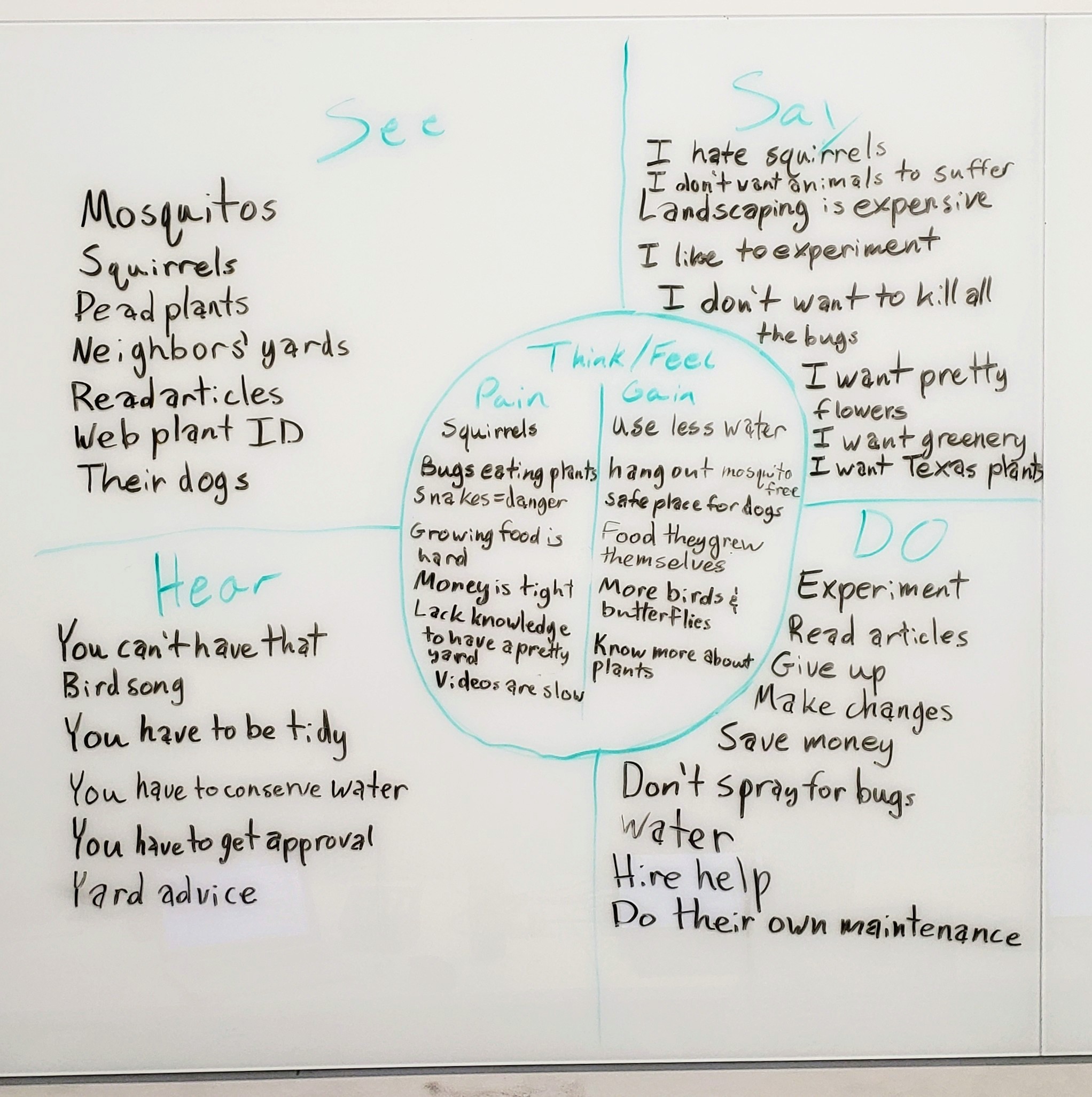
The analysis provided us with a profound insight. Our users were looking to solve specific problems to their yards and were not at all interested in this kind of online course. Most of them used Google to find blogs, articles or forums for solutions to either the same or similar problems. When we presented our findings, our client was relieved that she had not spent hundreds of hours working on a product no one would use.
Solve
With the knowledge from this research, my client asked my partner and I to help her find ways to increase her passive income and improve her website. Our client had some constraints. She didn’t have the additional funding for more User Research, requiring us to identify problems without users. We were also constrained to using Squarespace for hosting her website due to her limited knowledge in creating websites.
Identify
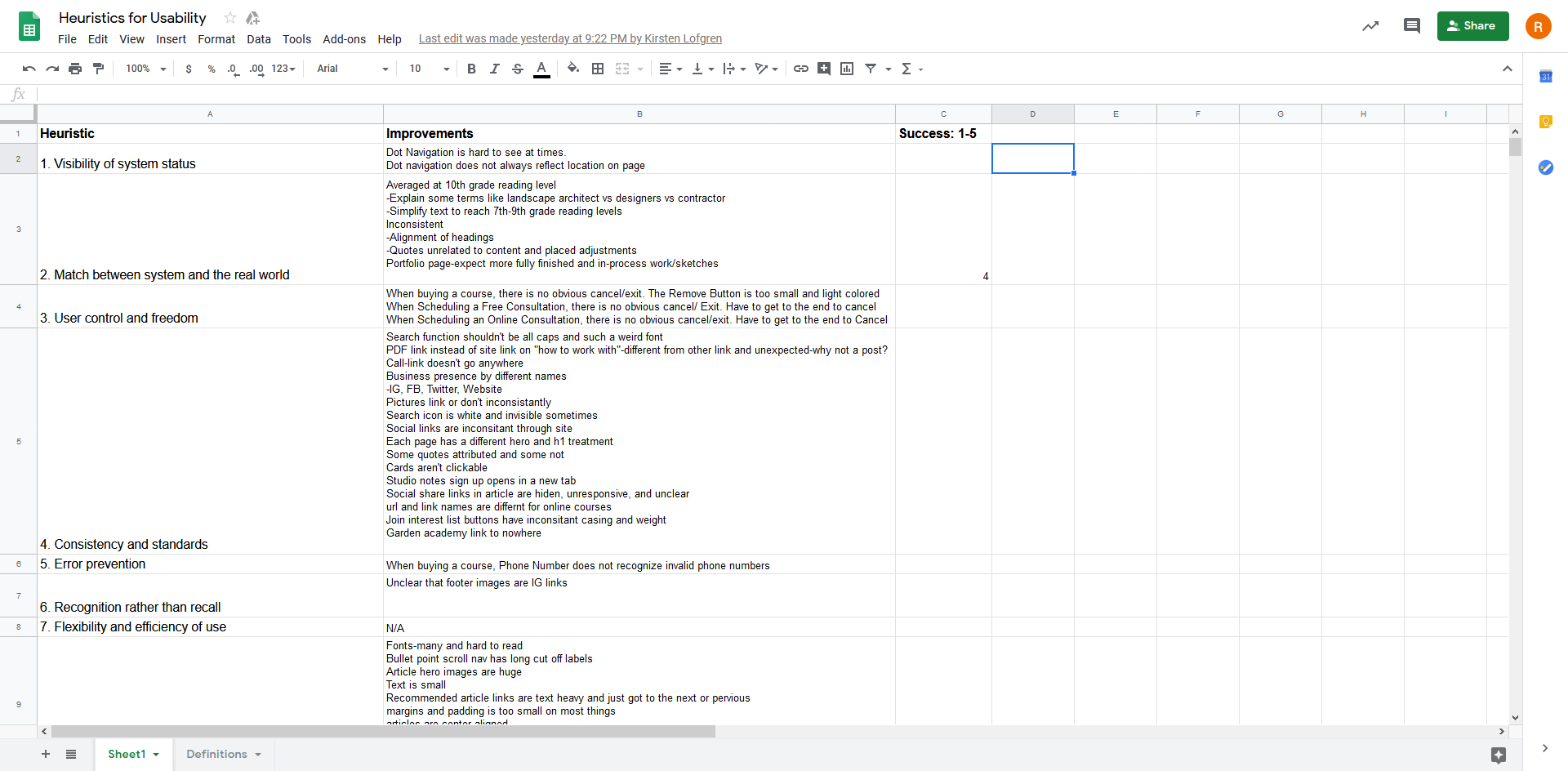
Without user input, we had to use Jakob Nielsen’s Heuristic Analysis to find basic usability issues as well as WebAIM to help find Accessibility issues. If we can fix basic issues with her site, she could improve her business and not need the income from another class.
We were able to identify about 40 issues ranging from visibility problems to inconsistent components.
Partial List of Issues Identified in Heuristic Analysis
Squarespace

Given the breath of issues, we knew we could not fix them all because of Squarespace. Squarespace is adequate for the basic needs of anyone who requires a website. It does not, however, make things easier for designers who are trying to improve usability. Some of issues were out of our control, such as error handling. This brought down the number of problems we could address.
Plan
We started with sketching ideas for layouts. The website was fine for someone who had to work with Squarespace templates but we knew we could do better. For example, we changed the home page to give it more verticality. That way it didn’t feel cramped, which, for a landscape architect, would reflect poorly on her skills.
Sketch of New Design for Home Page

Style Guide with Examples
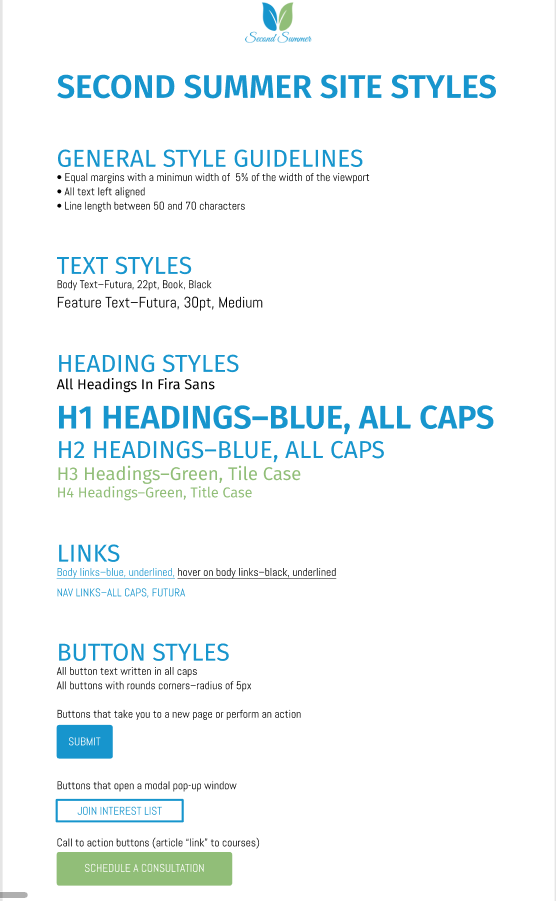
Next, we made a style guide. Our client had colors that were part of her brand, however she never really considered a style guide. We created a simple standard for her with examples and templates, allowing her to focus on content.
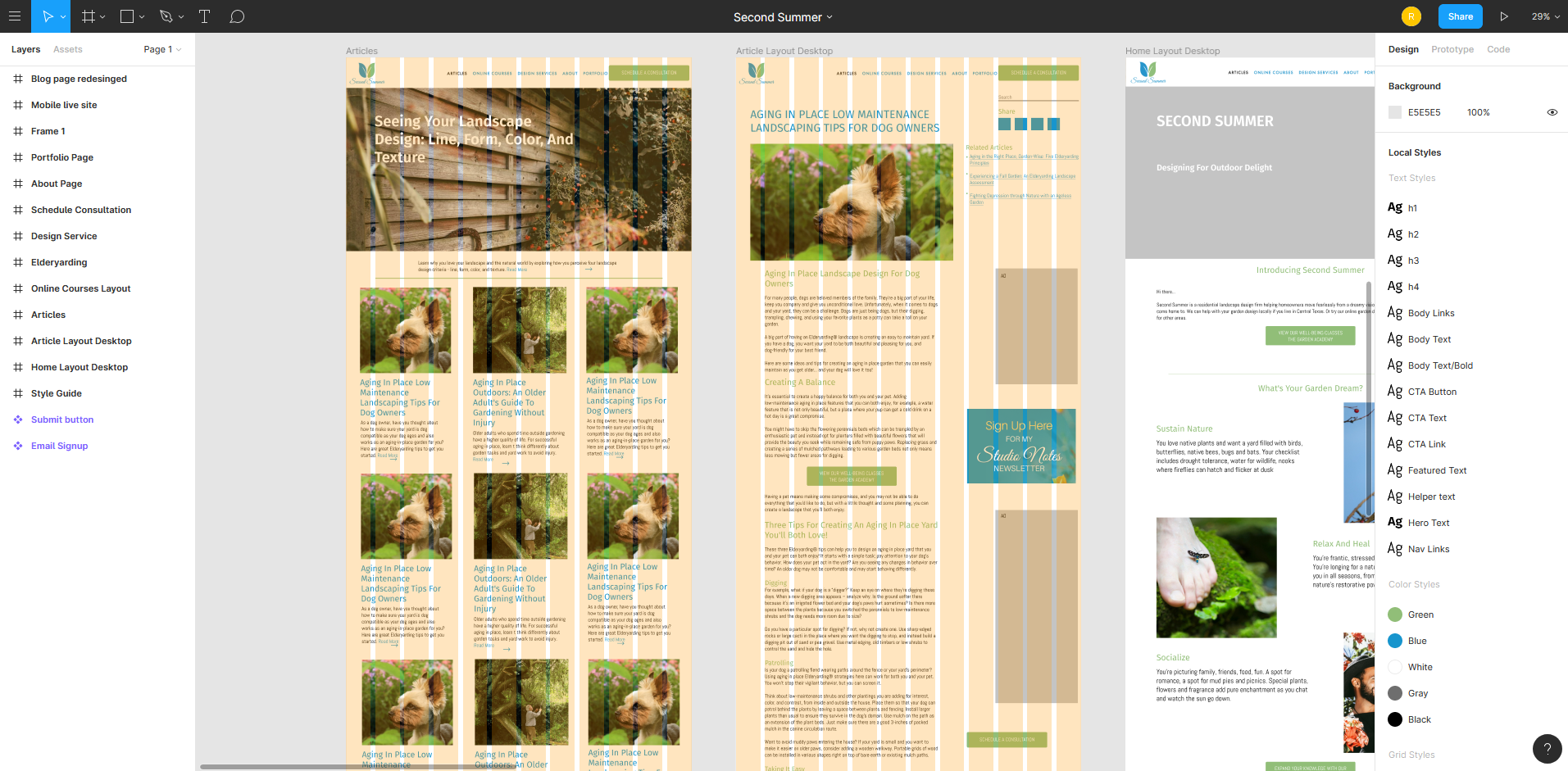
After the style guide, we made wireframes. Since we both worked remotely, my partner and I decided to try out Figma. I ended up being quite impressed with it, although their prototyping feature still needs some love. After presenting our work to the client, she gave us the go ahead to start working on implementing our design.
Wireframe of Articles Section of Website made in Figma
Build
Editing the website in Squarespace
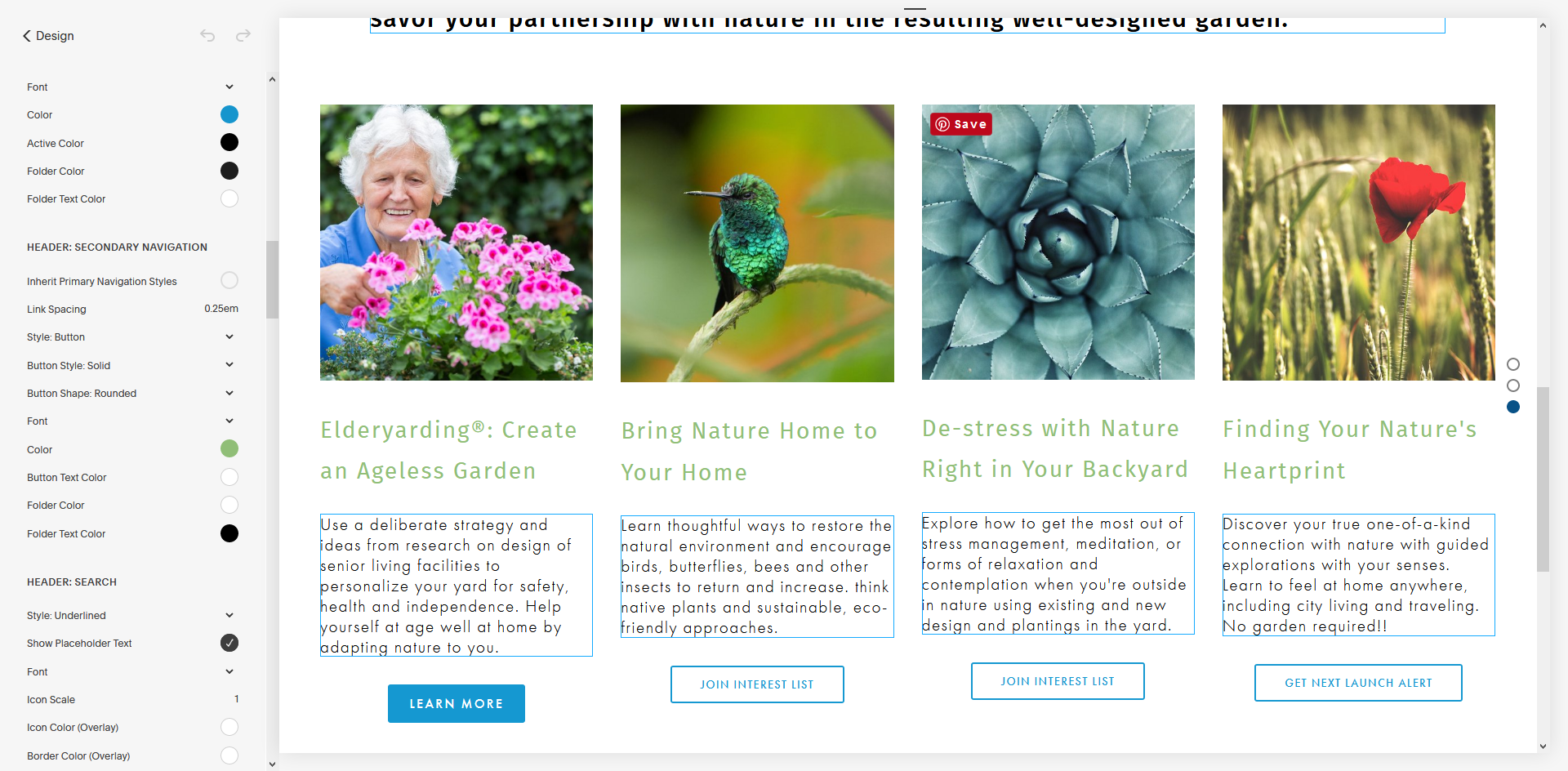
When you create a website on Squarespace, any changes you make can be saved without the website being visible to the world. However, once it's live, any new changes on an enabled page will go live immediately, and some changes would be seen across the entire website. We needed to find a way to make changes without the customers seeing our work until it was ready and without having to build a new site from scratch. So we came up with a plan to make the changes in 4 phases:
- Make copies of every page we’ll be changing (Not all pages could be changed due because of Squarespace’s tools)
- Alter the copies to the new layout design
- Swap the copies with the originals
- Add the new style designs
Test
When the site was complete, my partner and I tested every page, section, field, button, and link to make sure it went perfectly. Finally, when we had fixed all the errors, we launched it at night, when most of her clients would be asleep. As soon as we went live, I found a bug. The issue was a browser compatibility problem, which was out of our jurisdiction but we did let the client know.
Outcome
Overall, our client was pleased with our work. She missed some of the elements she had added to make the website look pretty but she could tell that it was a massive improvement from what she had before.
Retrospective
Looking back on this project, I learned a lot. Figma is a great tool to collaborate with and I look forward to using it more projects. I also learned that I don’t like Squarespace. It’s too restrictive. I would like to have built the site from scratch but our client needed to be able to make changes in the future on her own.
I wish I had joined the project when my partner first met with the client. I believe we could have questioned her some more to better understand her goals and perhaps had gone a different path in research. We did save her a lot of time, for which she thanked us, but I wonder if some more probing would have gotten us to the real heart of her problem.